

Quick answer: For most players, Wordle + Connections is the ideal daily stack — 12–15 minutes, two completely different puzzle types, and both are free. If you want more, add Strands and the Mini Crossword. Quordle is for veterans only; Spelling Bee is for word lovers with time to spare.
What Are These Daily Word Games?
Daily word games are browser-based puzzles — mostly hosted by the New York Times — that refresh every 24 hours. Each game gives every player the same puzzle on the same day, making them shareable on social media. Wordle started the format in 2021 when creator Josh Wardle built it as a private gift for his partner. It went viral, hit 300,000 players in a single week, and the New York Times acquired it for over $1 million. Since then, the NYT has expanded into a full Games suite, while independent developers have built popular spin-offs like Quordle.
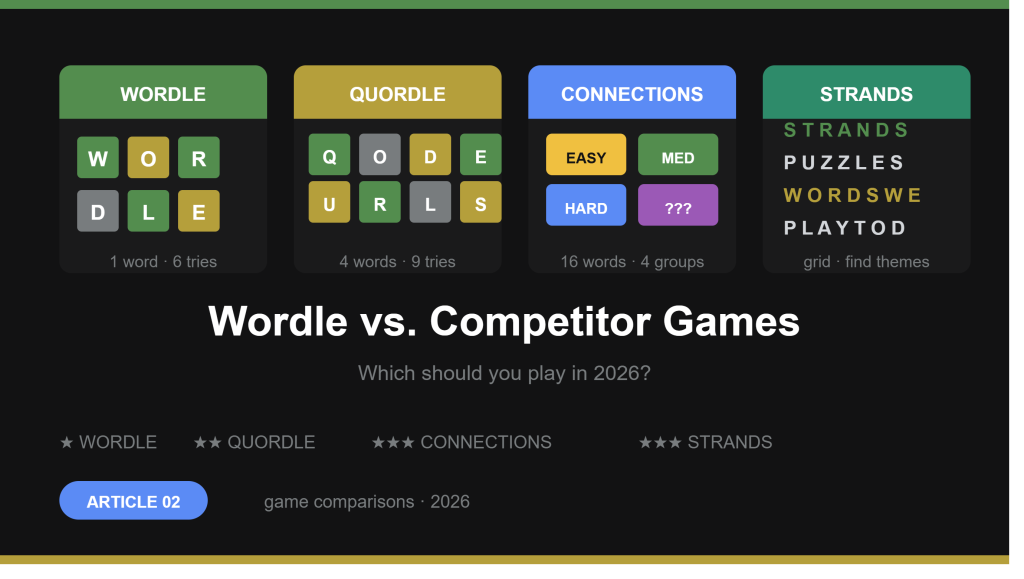
At a Glance: All Major Word Games Compared (2026)
| Game | Daily Puzzles | Difficulty | Time to Complete | Free? |
|---|---|---|---|---|
| Wordle | 1 (5-letter word) | Medium | 2–5 min | Yes |
| Quordle | 1 (4 words at once) | Hard | 5–10 min | Yes |
| Connections | 1 (16 words, 4 groups) | Medium | 3–6 min | Yes |
| Strands | 1 (themed grid) | Medium–Hard | 5–8 min | Yes |
| Spelling Bee | 1 (open-ended) | Easy–Hard | 5–30 min | Partial |
| Mini Crossword | 1 (5×5 grid) | Easy | 1–3 min | Yes |
| Octordle | 1 (8 words at once) | Very Hard | 10–20 min | Yes |
Which Word Game Is Best for You?
The best word game depends on how much time you have and what kind of thinking you enjoy. Here is a breakdown of each game’s strengths, weaknesses, and ideal player type.
How Does Wordle Work And Why Is It Still the Best Starting Point?
Wordle gives you six guesses to identify one five-letter word. Every guess must be a valid word. Green tiles mean the letter is correct and in the right position; yellow tiles mean the letter is in the word but in the wrong position; grey tiles eliminate the letter entirely.
What makes Wordle special is not complexity — it is constraint. One puzzle per day, shared globally, discussed everywhere. The emoji score grids you see posted on social media (“🟩🟨⬛🟩🟩”) turned a simple word game into a daily ritual for tens of millions of people worldwide, according to the New York Times Games division.
Wordle is best for: Players who want a quick, satisfying daily brain warm-up that takes under five minutes and connects them to a global community.
Wordle’s weakness: One puzzle a day is not enough for hardcore word game fans. Once you solve it, you wait until tomorrow.
What Is Quordle and How Does It Differ from Wordle?
Quordle runs four simultaneous Wordle grids. Every guess you type applies to all four boards at once, and you get nine total guesses to solve all four five-letter words. The strategic difference from Wordle is significant: early guesses must serve as information-gathering moves across all four boards rather than attempts to solve any single one.
Experienced Quordle players use a two-phase approach:
- Guesses 1–4: Cast wide nets to reveal letters across all grids
- Guesses 5–9: Solve the easiest grid first, then work toward the hardest
Quordle is best for: Wordle veterans who regularly solve Wordle in two or three guesses and want a genuine challenge.
Quordle’s weakness: The difficulty spike is steep. Casual players often find it frustrating rather than fun, especially when one difficult board wastes guesses needed elsewhere.
How Does NYT Connections Work?
Connections is a completely different kind of word puzzle. You see 16 words and must group them into four hidden categories of four words each. The categories are colour-coded by difficulty:
- 🟡 Yellow — Straightforward (e.g. types of fruit)
- 🟢 Green — Moderate
- 🔵 Blue — Tricky
- 🟣 Purple — Devious (e.g. words that can follow “fire” but have nothing to do with fire)
The key skill is resisting your first instinct. Many words appear to belong to an obvious category but actually belong to a hidden, lateral one. The purple category in particular often requires pop culture knowledge or wordplay awareness that goes well beyond vocabulary.
Connections is best for: Lateral thinkers who enjoy wordplay, cultural knowledge, and the satisfaction of spotting a non-obvious grouping.
Connections’ weakness: The purple category can feel unfair when it relies on obscure references. Some players find it alienating rather than challenging.
What Is NYT Strands and Why Is It Underrated?
Strands is the newest major NYT word game, launched in 2024, and it remains the most underplayed game in the suite. Each puzzle has a daily theme. Your job is to find all theme-related words hidden in a 6×8 letter grid. Every letter on the board is used exactly once across all the theme words.
The standout feature is the spangram a special word or phrase that spans the entire board from one side to the other and captures the day’s theme. Finding the spangram is the most satisfying moment in any NYT word puzzle.
Unlike Wordle or Connections, Strands rewards patience. You cannot brute-force it. You have to sit with the board, let the theme guide you, and trust that the letters will reveal themselves.
Strands is best for: Players who want a slower, more contemplative puzzle that rewards lateral thinking over speed.
Strands’ weakness: If the theme is obscure to you personally, the puzzle can feel impossible without hints.
What Is Spelling Bee and Is It Worth Playing?
Spelling Bee gives you seven letters arranged in a honeycomb and asks you to make as many words as possible, with every word containing the centre letter. There is no upper limit on how many words you can find. The game tracks your progress through ranks: Beginner, Moving Up, Good, Solid, Nice, Great, Amazing, and Genius.
Reaching Genius finding every possible word is something dedicated players spend hours achieving. The New York Times does not publish the full word list, which is part of the appeal and the frustration.
Spelling Bee is best for: Vocabulary enthusiasts who want an open-ended puzzle without a fixed endpoint. It is the only game on this list with no natural stopping point.
Spelling Bee’s weakness: Full access to the word list and some features requires a NYT Games subscription. It can also become a time sink that disrupts your day.
Frequently Asked Questions
Is Wordle still free in 2026?
Yes. Wordle remains completely free on the New York Times website with no account required. The NYT Games subscription is optional and unlocks additional features and archive access.
What is the hardest daily word game?
Octordle eight simultaneous Wordle grids with thirteen guesses — is the hardest in terms of raw difficulty. Among the main NYT games, Quordle is the most challenging, followed by Strands on difficult theme days.
Can I play all these games every day?
Yes. All games listed here offer one free puzzle per day. Playing all of them takes between 25 and 90 minutes depending on how long you spend on Spelling Bee.
Which game is best for beginners?
Start with Wordle. It teaches the core letter-elimination mechanic in two to five minutes. Once that feels comfortable, add Connections for a completely different challenge.
Are Wordle and Connections made by the same company?
Yes. Both are owned and operated by the New York Times. Wordle was acquired in January 2022; Connections launched in 2023 as an original NYT creation. Quordle is an independent game not affiliated with the NYT.
Which word game is best for improving vocabulary?
Spelling Bee is the strongest vocabulary-builder because it requires you to recall obscure words, not just recognise them. Wordle and Quordle strengthen pattern recognition and elimination logic more than raw vocabulary.
Our Verdict: Build Your Daily Word Game Routine
| Player Type | Recommended Stack | Time Needed |
|---|---|---|
| Casual (5 min/day) | Wordle only | ~5 min |
| Moderate (15 min/day) | Wordle + Connections | 12–15 min |
| Enthusiast (30 min/day) | Wordle + Connections + Strands + Mini | 25–30 min |
| Hardcore (1 hr+) | All of the above + Quordle + Spelling Bee | 60–90 min |
There is no wrong answer. The best word game is the one you actually play every day. Start with Wordle if you have not already — it remains the gold standard for a reason and add games as your appetite grows.